
Article Directory
- Introduction: The Critical Importance of Fiber Composition Verification in Modern Manufacturing
- 1.1 The Role of Fiber Analysis in Quality Control and Cost Management
- 1.2 Regulatory Compliance and Brand Protection
- 1.3 Target Audience: Textile Professionals and Procurement Specialists
- Chapter 1: Fundamental Principles of Fiber Identification
- 1.1 Natural vs. Synthetic Fibers: Key Distinguishing Characteristics
- 1.2 Common Fiber Blends in Industrial Applications
- 1.3 Sampling Methods and Preparation Techniques
- Chapter 2: Preliminary Identification Methods
- 2.1 Visual and Tactile Examination
- 2.2 Burn Test Methodology
- 2.3 Chemical Solubility Testing
- Chapter 3: Laboratory Analysis Techniques
- 3.1 Microscopic Analysis
- 3.2 Fourier Transform Infrared Spectroscopy (FTIR)
- 3.3 Thermogravimetric Analysis (TGA)
- 3.4 Chromatographic Methods
- Chapter 4: Quantitative Analysis of Fiber Blends
- 4.1 Chemical Dissolution Methods
- 4.2 Physical Separation Techniques
- 4.3 Statistical Analysis and Reporting
- Chapter 5: Industry-Specific Testing Considerations
- 5.1 Apparel and Textile Manufacturing
- 5.2 Carpet and Rug Production
- 5.3 Plush Toy Manufacturing
- 5.4 Specialized Industrial Applications
- Chapter 6: Implementing a Testing Protocol
- 6.1 In-House Testing vs. Third-Party Laboratories
- 6.2 Quality Assurance Documentation
- 6.3 Cost-Benefit Analysis of Different Testing Approaches
- Conclusion: Building a Comprehensive Quality Assurance Strategy
- 8.1 Future Trends in Fiber Analysis Technology
- 8.2 Recommendations for Industry Professionals
- Frequently Asked Questions (FAQ)
How to Test Fabric and Yarn Composition: A Comprehensive Guide for Textile Professionals
1. Introduction
In today’s global textile industry, verifying fiber composition is not merely a technical formality—it’s a fundamental business imperative. For procurement managers, quality control specialists, How to Test Fabric and Yarn Composition and production supervisors, accurate knowledge of fabric and yarn composition directly impacts product performance, manufacturing costs, regulatory compliance, and brand reputation.
The consequences of incorrect fiber identification can be severe:
- Financial losses from using improper materials
- Production delays due to material incompatibility
- Legal repercussions from mislabeling violations
- Brand damage from product failures
This comprehensive guide provides textile professionals with practical methodologies for fiber identification, ranging from simple field tests to sophisticated laboratory analyses, ensuring you can make informed decisions about material verification.
2. Fundamental Principles of Fiber Identification
2.1 Natural vs. Synthetic Fibers
Understanding basic fiber categories is essential for effective identification:
Natural Fibers:
- Cellulosic fibers: Cotton, linen, hemp, rayon
- Protein fibers: Wool, silk, cashmere, mohair
- Mineral fibers: Asbestos (largely obsolete), glass fiber
- Polymer-based: Polyester, nylon, acrylic, polypropylene
- Regenerated: Viscose, lyocell, acetate
- Specialty fibers: Aramid, carbon fiber, elastane
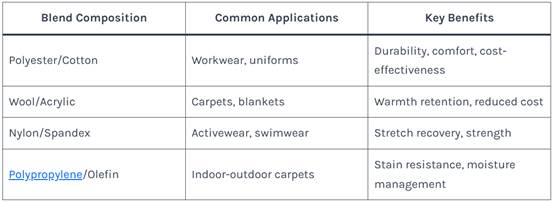
2.2 Common Industrial Blends
Most industrial textiles utilize fiber blends to optimize performance and cost:
3. Preliminary Identification Methods
3.1 Visual and Tactile Examination
Begin with simple observational techniques:
- Natural fibers typically have irregularities and natural variations
- Synthetic fibers often exhibit uniform diameter and luster
- Fabric hand feel can indicate fiber type (wool feels warm, polyester feels cool)
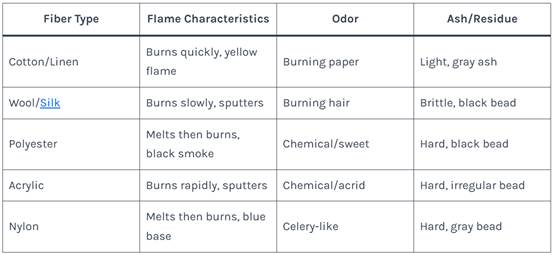
3.2 Burn Test Methodology
The burn test remains a valuable preliminary identification tool:
Safety Note: Always conduct burn tests in controlled environments with proper ventilation and fire safety equipment.
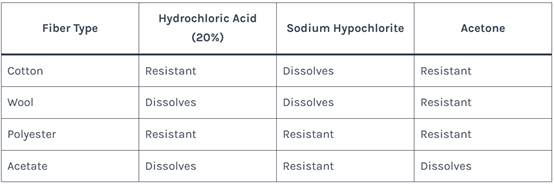
3.3 Chemical Solubility Testing
Chemical reactions provide additional identification clues:
4. Laboratory Analysis Techniques
4.1 Microscopic Analysis
Cross-sectional and longitudinal fiber examination provides definitive identification:
Key Microscopic Characteristics:
- Cotton: Twisted ribbon-like appearance, lumen visible
- Wool: Overlapping scales on surface
- Silk: Triangular cross-section, smooth longitudinal view
- Synthetics: Uniform diameter, often circular cross-section
4.2 Fourier Transform Infrared Spectroscopy (FTIR)
FTIR analysis identifies molecular structures through infrared absorption:
Applications:
- Quantitative analysis of fiber blends
- Detection of chemical treatments
- Identification of unknown fibers
Advantages:
- Non-destructive testing
- Rapid results (typically 1-2 minutes per sample)
- High accuracy for synthetic fibers
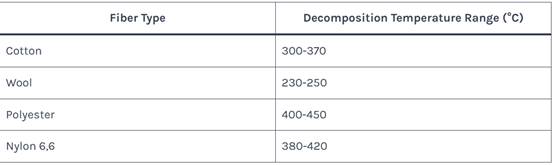
4.3 Thermogravimetric Analysis (TGA)
TGA measures weight changes during controlled heating:
4.4 Chromatographic Methods
Advanced techniques for complex analyses:
- Gas Chromatography-Mass Spectrometry (GC-MS) for detailed chemical analysis
- High-Performance Liquid Chromatography (HPLC) for dye and finish identification
5. Quantitative Analysis of Fiber Blends
5.1 Chemical Dissolution Methods
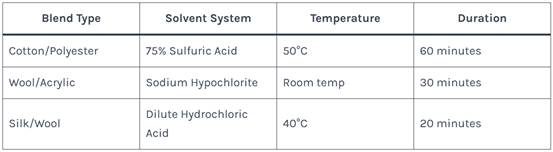
Standardized procedures for blend quantification:
ASTM D629 Test Methods:
- Method 1: Chemical separation using specific solvents
- Method 2: Mechanical separation and manual counting
- Method 3: Microscopical examination and point counting
Common Chemical Separation Procedures:
5.2 Accuracy Considerations
Quantitative analysis requires careful attention to:
- Sample preparation consistency
- Solution concentration accuracy
- Temperature control
- Residual fiber drying conditions
6. Industry-Specific Testing Considerations
6.1 Apparel and Textile Manufacturing
Priority Tests:
- Fiber content verification (regulatory compliance)
- Blend ratio confirmation (performance requirements)
- Finish identification (functional properties)
Common Challenges:
- Blended yarns with multiple fiber types
- Microfiber identification
- Recycled fiber content determination
6.2 Carpet and Rug Production
Critical Testing Parameters:
- Pile fiber composition
- Backing material analysis
- Dye penetration and uniformity
- Stain resistance treatments
Special Considerations:
- Bulk sampling requirements
- Wear testing correlation
- Colorfastness assessment
6.3 Plush Toy Manufacturing
Safety-Focused Testing:
- Fiber content for safety labeling
- Fill material composition
- Flame resistance verification
- Allergen potential assessment
Quality Considerations:
- Pile density and fiber length
- Color consistency
- Shedding resistance
7. Implementing a Testing Protocol
7.1 In-House Testing Capabilities
Minimum Equipment Requirements:
- Precision analytical balance (±0.0001g)
- Laboratory oven and desiccator
- Basic chemical testing kit
- Stereo microscope (40-100x magnification)
Staff Training Requirements:
- Basic laboratory safety
- Standard test method proficiency
- Documentation procedures
- Quality control protocols
7.2 Third-Party Laboratory Services
When to Use External Testing:
- Complex fiber blends
- Regulatory certification requirements
- Dispute resolution
- Advanced analytical needs
Selecting a Laboratory:
- Accreditation (ISO 17025 preferred)
- Industry-specific expertise
- Turnaround time considerations
- Cost structure transparency
7.3 Cost Analysis
Typical testing cost ranges:
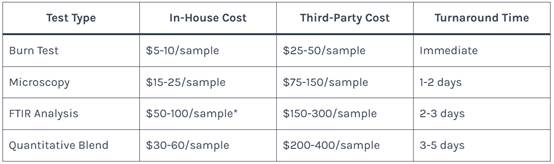
*Requires capital equipment investment
8. Conclusion
Developing a robust fiber identification program requires a balanced approach combining practical field tests with precise laboratory analyses. The optimal strategy depends on your specific industry requirements, available resources, and quality objectives.
Key Recommendations:
- Establish clear testing protocols based on material requirements
- Maintain detailed documentation for traceability and compliance
- Invest in staff training to ensure consistent results
- Regularly validate testing methods through proficiency testing
- Stay informed about technological advancements in fiber analysis
The textile industry continues to evolve with new fibers, blends, and sustainability initiatives. A proactive approach to fiber identification not only protects your business but can also create competitive advantages through superior material knowledge and quality assurance.
9. Frequently Asked Questions (FAQ)
Q1: What is the most accurate method for fiber identification?
A: While no single method is universally superior, FTIR spectroscopy combined with microscopic analysis typically provides the highest accuracy for most applications, achieving 95-99% reliability for common fibers.
Q2: How much sample is needed for accurate testing?
A: Requirements vary by method. Burn tests can be done with a few fibers, while quantitative blend analysis typically requires 1-5 grams. For representative sampling of bulk materials, follow ASTM D1776 or ISO 5089 standards.
Q3: Can recycled fiber content be accurately determined?
A: Yes, but with limitations. Physical properties and chemical signatures can indicate recycled content, but precise quantification often requires specialized testing and knowledge of the source material.
Q4: How do I test for elastane/spandex in blends?
A: Elastane is typically identified through chemical solubility tests (soluble in dimethylformamide) or through microscopic examination of its unique segmented structure.
Q5: What certifications should a testing laboratory have?
A: Look for ISO 17025 accreditation, which ensures technical competence. Industry-specific certifications (AATCC, ASTM proficiency) and relevant scope accreditation for textile testing are also important.
Q6: How often should we verify fiber content from suppliers?
A: Establish a risk-based schedule. New suppliers should have 100% verification initially. Established suppliers with good track records might require quarterly or semi-annual testing, with random spot checks in between.
Q7: What’s the difference between qualitative and quantitative fiber analysis?
A: Qualitative analysis identifies which fibers are present, while quantitative analysis determines the percentage of each fiber in a blend. Both are often needed for complete characterization.
Q8: Can fiber finishes interfere with identification tests?
A: Yes, chemical treatments can alter burn characteristics and solubility. In such cases, preliminary cleaning or advanced techniques like FTIR may be necessary.
Q9: How long does comprehensive fiber testing typically take?
A: Preliminary tests can be completed in minutes to hours. Full quantitative analysis with third-party verification typically requires 3-7 business days, depending on complexity and laboratory workload.
Q10: What are common mistakes in fiber identification?
A: Common errors include inadequate sample preparation, contamination during testing, misinterpreting burn test results (especially with blends), and using outdated reference materials for comparison. Regular training and method validation can minimize these errors.